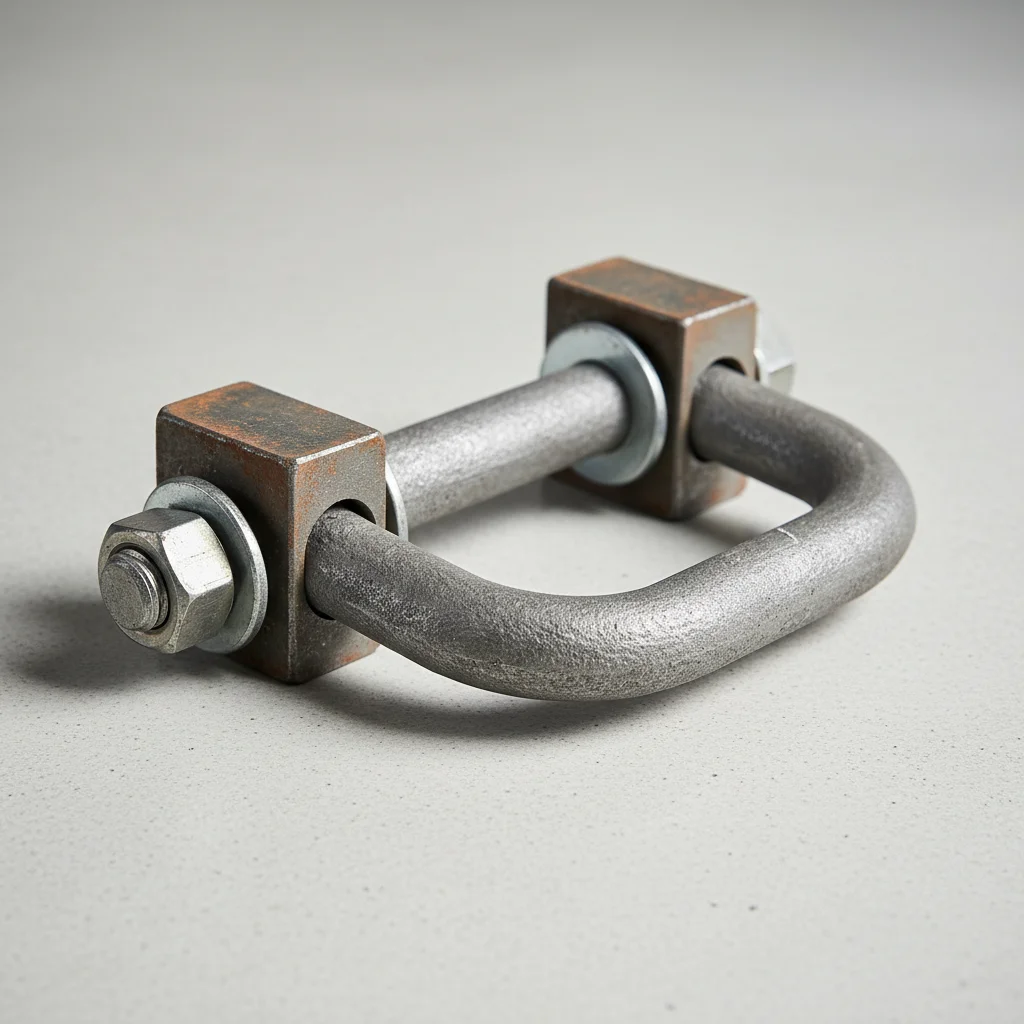
Wholesale U bolts are critical heavy-duty fasteners designed to provide high clamping force and structural stability, primarily used in trailer suspensions, automotive axles, and industrial pipe supports. These specialized bolts feature a U-shaped bend with threads on both ends, allowing them to secure two components tightly together against a rigid base, ensuring that axles remain aligned and components stay fixed under extreme vibration.
In the demanding environment of logistics and construction, substandard fasteners often lead to catastrophic failures, including axle misalignment, rapid corrosion, and unplanned vehicle downtime. For procurement managers and fleet operators, sourcing high-grade, certified U-bolts is not merely a cost consideration but a critical safety requirement to prevent cargo damage and ensure compliance with international transport regulations.
This comprehensive guide examines the technical specifications, material grades, and procurement strategies for wholesale U bolts. By analyzing the differences between hot-dip galvanizing and electro-plating, and exploring SAE and ASTM standards, this article will help you identify the optimal fastening solutions to extend equipment service life and reduce long-term maintenance costs.

1Fundamental Engineering of U-Bolts

The design of wholesale U bolts focuses on the distribution of clamping pressure across a curved surface. Unlike standard bolts, the U-shape allows for a simultaneous grip on multiple components, which is essential for securing leaf springs to axles in heavy-duty trailers. The precision of the bend radius is the most critical dimensional factor; even a minor deviation can lead to uneven torque distribution and premature fastener fatigue.
From a manufacturing perspective, these components are produced through cold forging or hot rolling followed by precision threading. The choice of threading—whether UNC, UNF, or Metric—depends on the regional standard of the vehicle or machine. Ensuring the thread pitch is consistent across large batches is vital for automated assembly lines used by major OEMs.
Furthermore, the integration of high-strength nuts and washers is necessary to prevent loosening caused by the constant vibration of road transport. The interaction between the bolt material and the nut material must be carefully matched to avoid galvanic corrosion, especially when using different grades of steel.
2Material Grades and Structural Integrity
Selecting the correct material grade is the foundation of structural safety. For most trailer applications, SAE J429 Grade 5 and Grade 8 are the industry benchmarks. Grade 5 provides a balance of strength and ductility, while Grade 8 is reserved for extreme loads where higher tensile strength is required to prevent bolt stretching under maximum cargo capacity.
For environments with high chemical exposure or marine conditions, AISI 304 or 316 stainless steel is often specified. While stainless steel offers superior rust resistance, it generally has lower tensile strength than alloy steels, making it more suitable for light-to-medium duty applications or specialized chemical pipe supports.
ASTM A307 is another common standard for low-carbon steel bolts, typically used in non-critical structural applications. Procurement teams must balance the cost-effectiveness of A307 with the high-performance requirements of J429 Grade 8 to optimize the total cost of ownership without compromising safety.
3Critical Application Scenarios in Logistics
In the semi-trailer industry, U-bolts are indispensable for the connection between the axle and the suspension system. In 40-ton flatbed or reefer trailers, these fasteners endure millions of stress cycles. Failure in this area does not just result in a broken part; it can cause the entire axle to shift, leading to dangerous highway accidents and complete vehicle immobilization.
Beyond road transport, heavy-duty lowboys and dump trailers used in construction require U-bolts with higher vibration resistance. These vehicles often operate on uneven terrain, where the clamping force of the U-bolt is tested by constant jarring and shifting loads, necessitating the use of high-hardness materials and precise torquing specifications.
Agricultural trailers present a different challenge: exposure to organic acids and manure. In these scenarios, hot-dip galvanizing is the only viable option, as it provides a thick, sacrificial zinc layer that protects the base steel from aggressive chemical corrosion over several years of service.
4Comparative Performance and Technical Data
When evaluating wholesale U bolts, the primary metrics for success are tensile strength, yield point, and salt spray resistance. High-performance U-bolts engineered for a 10-year service life typically exhibit salt spray resistance exceeding 1,200 hours, whereas standard commercial alternatives often fail around the 200-400 hour mark.
The relationship between coating thickness and longevity is linear; a coating of 85–120 µm (standard for hot-dip galvanizing) provides significantly more protection than the thin layers found in zinc-plated fasteners. This difference is critical for fleet operators who wish to reduce the frequency of suspension overhauls.
wholesale u bolts Performance Metrics
Data indicates that using certified Grade 8 fasteners reduces the rate of thread stripping and nut loosening by over 60% compared to uncertified hardware. This reduction directly translates to lower maintenance labor costs and higher vehicle uptime for large-scale logistics fleets.
5Procurement Standards and Quality Control
For professional buyers, the "lowest price" is rarely the "lowest cost." Procurement of wholesale U bolts should be based on mill certificates and third-party inspections. A reliable supplier must provide full traceability, including the heat number of the steel used, to ensure that the mechanical properties match the requested SAE or ASTM standards.
Quality control should involve a multi-stage process: incoming raw material chemical analysis, in-process dimensional checks using calibrated gauges, and final tensile testing. For high-volume orders, implementing an AQL (Acceptable Quality Level) sampling plan ensures that the batch consistency is maintained without needing to test every single piece.
Furthermore, evaluating the supplier's production capacity is essential. A factory with automated forging lines and in-house QC labs can offer shorter lead times and more consistent quality than those relying on outsourced plating or threading services.
6Corrosion Mitigation and Coating Analysis
The choice of surface treatment determines the lifespan of the fastener in the field. Electro-galvanizing is cost-effective and provides a smooth finish, but it is insufficient for outdoor heavy-duty use. Hot-dip galvanizing (HDG) involves immersing the bolt in molten zinc, creating a metallurgical bond that is far more resilient to abrasion and impact.
Advanced coatings such as Dacromet or Geomet are increasingly popular for EV transport trailers and specialized equipment. These zinc-flake coatings offer high corrosion resistance without the risk of hydrogen embrittlement associated with acid pickling in the galvanizing process, making them ideal for ultra-high-strength bolts.
Understanding the trade-off between coating thickness and thread fit is crucial. HDG adds significant thickness to the threads, which may require the nuts to be over-tapped to ensure a smooth fit. Failure to account for this often leads to installation delays and forced part replacements on the assembly line.
7Selection Matrix for Industrial Buyers
To optimize the selection of wholesale U bolts, buyers must match the material grade and coating to the specific operational environment. A bolt that is over-engineered for a light-duty application increases unnecessary costs, while an under-engineered bolt in a heavy-duty application creates a liability risk.
The following matrix provides a comparative look at the most common specifications used in the fastener industry today, highlighting the strengths and limitations of each approach.
| Material Grade | Typical Coating | Best Use Case | Primary Limitation |
|---|---|---|---|
| SAE Grade 5 | Electro-Zinc | Light Trailers | Low Corrosion Resistance |
| SAE Grade 8 | Hot-Dip Galv. | Heavy-Duty Axles | Higher Material Cost |
| ASTM A307 | Plain/Zinc | General Support | Low Tensile Strength |
| AISI 304 SS | None/Passivated | Marine/Chemical | Potential for Galling |
| AISI 316 SS | None/Passivated | Extreme Salinity | High Procurement Cost |
| Alloy 4140 | Geomet/Dacromet | Precision OEM | Complex Processing |
Ultimately, the decision should be driven by the expected service life and the cost of failure. For critical suspension components, the investment in Grade 8 hot-dip galvanized bolts is almost always offset by the reduction in maintenance intervals and the mitigation of safety risks.
Frequently Asked Questions
Conclusion
Selecting the right wholesale U bolts is a critical decision that impacts the safety, longevity, and operational efficiency of any heavy-duty transport or industrial system. By prioritizing material certification, choosing the appropriate coating for the environment, and ensuring precision in bend radii, procurement teams can significantly reduce the risks of structural failure and unplanned maintenance downtime.
For organizations seeking reliable, high-performance fastening solutions that meet international SAE and ASTM standards, reviewing the technical capabilities and product range at www.maxfastener.com can provide the necessary guidance for optimizing your supply chain and ensuring the structural integrity of your fleet.