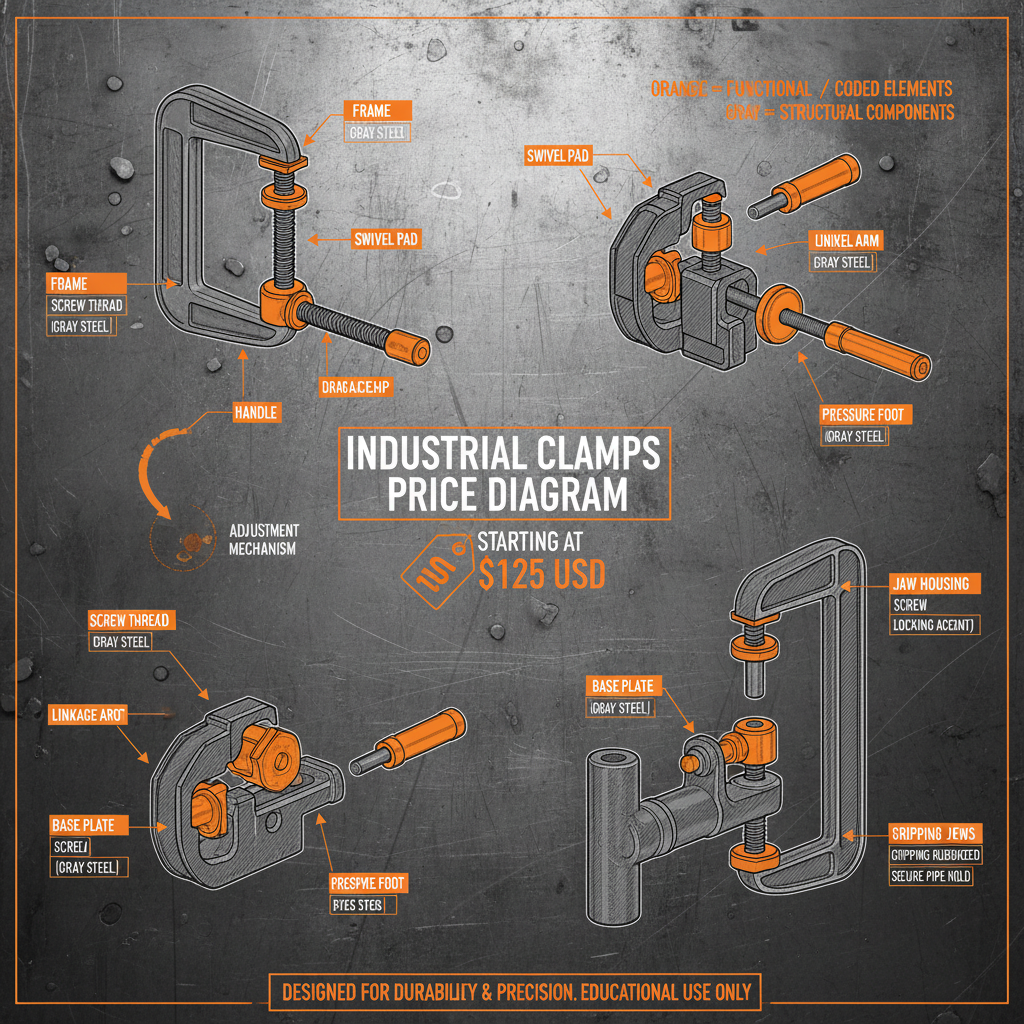
When managing industrial infrastructure projects, procurement teams often focus on the immediate clevis hanger price to stay within budget. However, in the B2B fasteners sector, the unit cost is only one variable in a complex equation involving material durability, structural safety, and installation speed. Understanding the relationship between cost and quality is essential to avoid expensive on-site failures and rework.
Industrial piping systems—ranging from HVAC in commercial towers to process piping in chemical plants—demand supports that can withstand specific thermal stresses and load requirements. Choosing the cheapest available component often leads to a higher Total Cost of Ownership (TCO) due to corrosion or structural instability. This article analyzes the primary cost drivers for pipe supports and provides a framework for balancing budget constraints with engineering requirements.
Readers will discover how material selection, such as Stainless Steel 316 versus zinc-plated carbon steel, impacts long-term value. We will also examine the technical specifications that justify premium pricing and how to evaluate suppliers based on production capacity and quality certifications to ensure project timelines are met without compromising safety.
Commercial Factors of Pipe Support Costs
The pricing of industrial pipe hangers is not arbitrary; it is driven by a combination of raw material market volatility, manufacturing precision, and compliance standards. For instance, the difference between a generic support and an engineered solution often lies in the tolerance levels. A precision-engineered hanger with a ±0.5mm tolerance requires advanced CNC machining and stricter quality control, which increases the initial cost but significantly reduces labor expenses during installation. In large-scale projects, a 24% drop in installation efficiency—often caused by ill-fitting components—can outweigh any savings gained from purchasing low-cost hardware. Furthermore, the global industrial fasteners market, valued at nearly $96.4 billion, reflects a trend where procurement managers are shifting from "lowest bid" to "best value" to mitigate risks associated with project delays and inspection failures.
Evaluating Value Beyond Initial Unit Costs
To optimize procurement, engineers and buyers must look past the sticker price and analyze the operational lifecycle of the component. The following dimensions detail how technical specifications directly correlate with the financial viability of a project.
Material Grade Influence
The choice of material is the most significant driver of the clevis hanger price. Zinc-plated carbon steel is cost-effective for indoor, non-corrosive environments. However, for marine or chemical applications, SS304 or SS316 is mandatory to prevent oxidation. While stainless steel has a higher upfront cost, its ability to withstand aggressive environments for 15+ years eliminates the need for frequent replacements, which is far more expensive in terms of downtime and labor.
| Material Grade | Corrosion Resistance | Typical Application | Value Proposition |
|---|---|---|---|
| Zinc-Plated Steel | Low/Moderate | Indoor HVAC / Plumbing | Lowest initial investment |
| SS304 Stainless | High | Food & Beverage Plants | Balanced cost and durability |
| SS316 Stainless | Very High | Chemical / Marine Plants | Maximum lifecycle value |
| Hot-Dip Galv. (HDG) | High | Outdoor Infrastructure | Excellent outdoor protection |
| Dacromet/Xylan | Specialized | High-Temp / Sour Service | Extreme environment reliability |
| Carbon Steel | None | Temporary Structures | Short-term cost efficiency |
Load Capacity vs. Expense
Load ratings determine the safety factor of a piping system. High-capacity hangers, tested up to 2,400N, require thicker gauges and superior forging techniques. While these are more expensive than light-duty clips, they prevent catastrophic failures in heavy-duty process piping. Procurement teams should evaluate the maximum load requirements of their specific DN size to avoid "over-specifying" (which wastes budget) or "under-specifying" (which risks safety).
Precision Engineering Tolerances
Consistent dimensions are critical for BIM (Building Information Modeling) workflows. Components produced in a 30,000㎡ facility with 120+ precision CNC machines ensure that every piece fits exactly as designed. Inconsistent tolerances lead to on-site adjustments, which can increase rework costs by up to 37%. Investing in a supplier with a defective rate below 0.05% is a strategic move to protect the overall project budget.
Installation Efficiency Factors
The "installed cost" is more important than the "purchase price." Features like pre-assembled EPDM rubber inserts or modular snap-fit designs reduce vibration and noise while speeding up the rough-in process. For a mechanical contractor, saving 20 minutes per hanger across a project of 10,000 units results in hundreds of man-hours saved, easily offsetting a slightly higher component cost.
Corrosion Protection Costs
Surface treatments such as Hot-Dip Galvanization (HDG) add a layer of protection that extends the life of carbon steel. The cost of these treatments depends on the thickness of the coating and the standards followed (e.g., ASTM or EN). When evaluating quotes, buyers should verify the salt spray test hours; a coating that lasts 200 hours provides significantly more value than one that lasts only 48 hours.
Supply Chain Lead Times
Time is money in construction. A supplier capable of a 15-day lead time for bulk orders of 50,000 pieces prevents costly project idling. Guanbiao's investment in automated warehousing to reduce delivery times by 40% demonstrates how operational efficiency at the factory level translates into financial savings for the end buyer by keeping the project on schedule.
TCO Analysis for Procurement
Total Cost of Ownership (TCO) = Purchase Price + Installation Labor + Maintenance + Replacement Costs. A low-cost hanger that fails after 3 years in a corrosive environment costs 5x more over a decade than a premium SS316 hanger that lasts 20 years. Procurement professionals should use a 10-year NPV (Net Present Value) calculation to justify the selection of higher-grade components to stakeholders.
FAQ
What factors most influence the price of industrial pipe hangers?
The primary drivers are material choice (e.g., SS316 vs. Carbon Steel), the load-bearing rating, surface treatment (like Hot-Dip Galvanization), and the precision of the manufacturing process. Additionally, order volume and customization requirements for non-standard diameters or standoff heights can impact the final quote.
Is it ever worth paying a premium for high-precision pipe supports?
Yes, especially in large-scale industrial projects. Precision supports with tight tolerances (±0.5mm) eliminate the need for field improvisation and manual adjustments. This can reduce installation labor costs by up to 24% and significantly lower the risk of rework, which often costs far more than the price difference of the hardware itself.
How do I evaluate if a supplier's price is fair for the quality provided?
Look for verifiable data: ISO 9001 certification, material certificates (EN 10204 3.1), and a proven defect rate (e.g., below 0.05%). A fair price is one that balances the material cost with the reliability of the supply chain, the manufacturer's production capacity, and the technical support provided for custom OEM/ODM needs.
What is the cost impact of choosing Stainless Steel 316 over SS304?
SS316 contains molybdenum, which provides superior resistance to chlorides and marine environments. While the initial purchase price is higher than SS304, it prevents pitting and crevice corrosion in aggressive settings. In chemical plants or coastal installations, the cost of replacing failed SS304 components makes SS316 the more economical choice over the long term.
Can bulk ordering significantly reduce the unit price of pipe supports?
Yes, B2B pricing is heavily tiered based on volume. High-capacity factories can optimize raw material procurement and machine setup times for large runs. For example, orders exceeding 2,000 pieces per size typically qualify for wholesale pricing, and trial packs are often available for qualified procurement teams to verify quality before committing to bulk orders.
Does a shorter lead time usually mean a higher price?
Not necessarily if the supplier has invested in automation. A manufacturer with a 30,000㎡ base and automated forging lines can maintain fast lead times (e.g., 15 days) without charging "rush" premiums. The efficiency of the production line allows them to offer competitive pricing while maintaining high delivery speed.
References and further reading
- Industrial Fastener Market Trends 2025 - Analysis of global demand and CAGR in process piping supports.
- ResearchAndMarkets.com - Report on the impact of misaligned pipe components on construction rework costs.
- LISEGA SE - Research on modular adjustable support systems and installation efficiency in industrial plants.
- ASTM International - Standards for corrosion-resistant coatings and material specifications for industrial hangers.
Related Articles