Clamps design represents a critical intersection of engineering, material science, and practical application, influencing a vast spectrum of industries globally. From the intricate machinery of aerospace to the fundamental infrastructure of construction, well-designed clamps ensure safety, efficiency, and longevity of systems. Understanding the nuances of clamps design is crucial for optimizing performance, reducing maintenance costs, and mitigating potential risks. It’s a seemingly simple component, but its effective design is paramount to the success of complex projects.
The global market for clamps and related fastening solutions is substantial and continuously growing, driven by expanding infrastructure development in emerging economies and the increasing demand for high-performance materials in established markets. According to industry reports, the global fastening market was valued at over $80 billion in 2022 and is projected to reach over $100 billion by 2028. This growth underscores the vital role of clamps in modern industry, with innovations constantly striving to improve clamping force, corrosion resistance, and ease of installation. The ability to effectively address these demands is where advancements in clamps design are crucial.
The importance of clamps extends beyond mere mechanical function. In critical applications like medical equipment, secure and reliable clamping is directly linked to patient safety. In disaster relief scenarios, robust and rapidly deployable clamps are essential for assembling temporary shelters and infrastructure. This highlights the far-reaching implications of thoughtful and innovative clamps design, impacting not only industrial processes but also humanitarian efforts and quality of life.
Introduction to Clamps Design
Effective clamps design requires a thorough understanding of load distribution, material properties, and the specific environmental conditions in which the clamp will operate. Factors like vibration, temperature fluctuations, and corrosive substances must be carefully considered to ensure long-term reliability and prevent failure. Achieving optimal clamping force without damaging the clamped components is a key challenge, often necessitating the use of advanced modeling and simulation techniques.
The process of clamps design isn't simply about selecting a standard component; it frequently involves custom engineering solutions tailored to unique application requirements. This may include incorporating specialized materials, adjusting geometric parameters, or integrating features like quick-release mechanisms. A well-executed design not only provides secure fastening but also simplifies assembly and maintenance procedures, ultimately reducing overall operational costs.
Defining Clamps Design
Clamps design, at its core, is the process of conceiving, engineering, and optimizing mechanical devices used to securely fasten or hold objects together. It encompasses selecting appropriate materials, determining optimal geometries, calculating clamping forces, and considering factors like corrosion resistance and fatigue life. It goes beyond simply 'holding things together' and focuses on providing reliable, durable, and often reusable connections.
The field draws heavily on principles of mechanical engineering, materials science, and manufacturing processes. A successful clamp design must not only withstand the intended loads but also prevent damage to the components being clamped, while offering ease of installation and removal. The complexity of this process is often underestimated, especially in situations requiring high precision or extreme environmental resilience.
In the context of modern industry and humanitarian needs, clamps design plays a vital role in ensuring structural integrity, operational safety, and efficient resource utilization. Whether it's securing pipelines in offshore oil rigs or rapidly deploying temporary shelters in disaster zones, well-designed clamps are essential for building a more resilient and sustainable future.
Core Factors in Clamps Design
Several key factors underpin effective clamps design. Durability is paramount, necessitating the selection of materials and construction techniques that can withstand the intended operating conditions and prevent premature failure. Material selection often involves trade-offs between cost, strength, weight, and corrosion resistance, with options ranging from carbon steel and stainless steel to aluminum alloys and composite materials.
Scalability refers to the ability to adapt the clamp design to accommodate varying sizes and shapes of components. Modular designs, with adjustable features and interchangeable parts, offer excellent scalability, reducing the need for custom engineering for each unique application. Cost-efficiency is another crucial consideration, balancing performance requirements with manufacturing costs and material expenses.
Corrosion resistance is critical in many applications, particularly those exposed to harsh environments. Selecting corrosion-resistant materials, applying protective coatings, or incorporating sacrificial anodes can significantly extend the service life of clamps and reduce maintenance requirements. Finally, ease of installation and removal are important factors, influencing assembly time, labor costs, and the potential for human error.
Applications of Clamps Design
Clamps are ubiquitous across a vast array of industries. In the automotive sector, they secure hoses, pipes, and exhaust systems, contributing to vehicle safety and performance. The aerospace industry relies on highly specialized clamps to fasten critical components in aircraft engines and airframes, where precision and reliability are non-negotiable.
In construction, clamps play a vital role in securing scaffolding, supporting temporary structures, and fastening building materials. The oil and gas industry utilizes robust clamps to secure pipelines, valves, and other essential equipment, often in challenging offshore environments. In post-disaster relief operations, quick-deployable clamps are invaluable for assembling temporary shelters, medical facilities, and infrastructure.
Furthermore, in remote industrial zones – such as mining operations in challenging terrains – durable and easily maintainable clamps are critical for ensuring equipment uptime and minimizing disruptions to production. This demonstrates the truly global reach of effective clamps design, impacting both developed and developing nations.
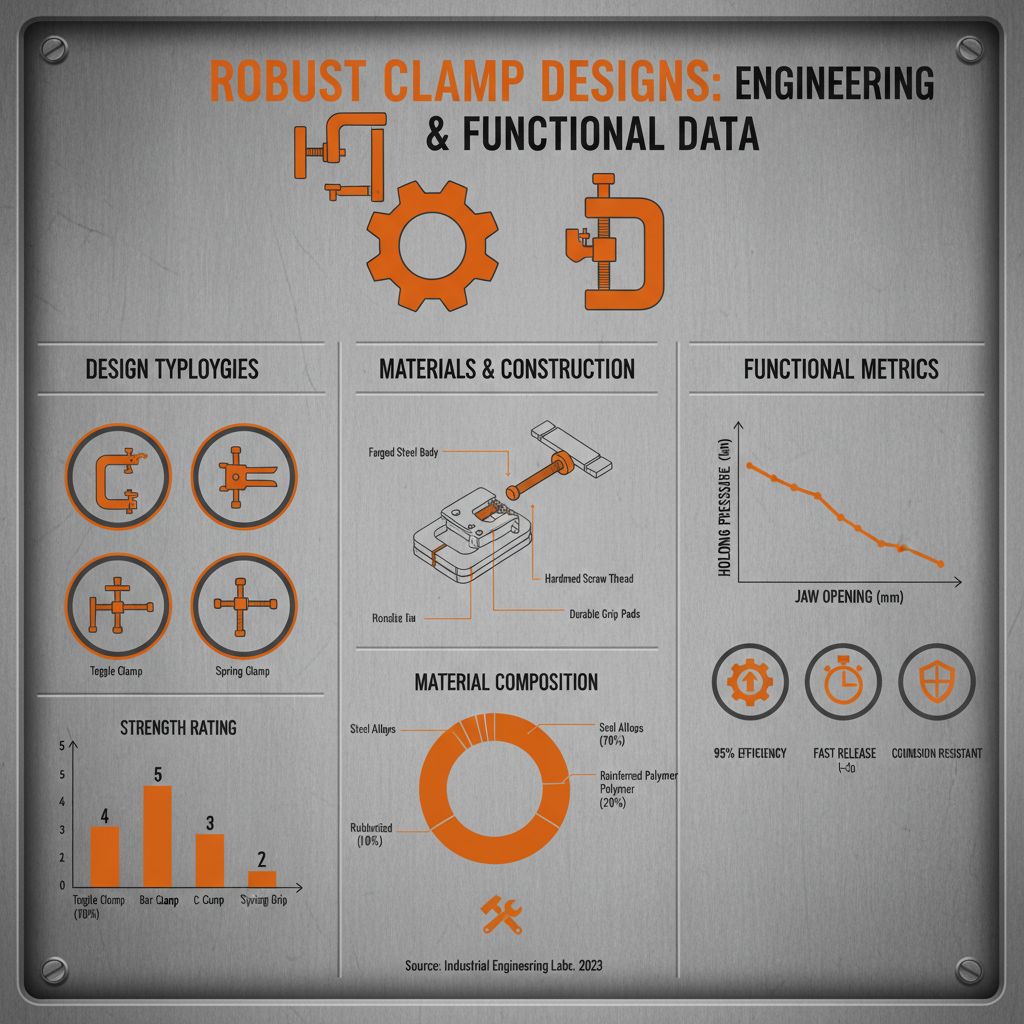
Clamps Design Performance Metrics
Advantages & Long-Term Value
The benefits of robust clamps design extend beyond immediate functionality. Cost savings are realized through reduced maintenance requirements, longer component lifespan, and minimized downtime. Sustainable design, utilizing recyclable materials and optimizing resource utilization, contributes to environmental responsibility.
Moreover, enhanced safety is a direct outcome of reliable clamping, preventing accidents and protecting personnel. From a social impact perspective, durable and reliable infrastructure – supported by effective clamp designs – improves quality of life and fosters economic development. The trust engendered by a well-engineered clamping system is invaluable, especially in critical applications where failure is not an option.
Future Trends & Innovations
Several trends are shaping the future of clamps design. The integration of smart materials – such as shape memory alloys and self-healing polymers – offers the potential for adaptive clamping systems that respond to changing conditions. Digital transformation, including the use of advanced simulation software and machine learning algorithms, is accelerating the design process and optimizing performance.
Automation and robotics are playing an increasingly important role in clamp manufacturing and installation, improving efficiency and reducing labor costs. Furthermore, a growing emphasis on sustainability is driving the development of eco-friendly materials and designs that minimize environmental impact. The push for lightweighting, particularly in the aerospace and automotive industries, will continue to fuel innovation in clamp materials and geometries.
Challenges & Solutions in Clamps Design
Despite advancements, several challenges remain in clamps design. Achieving optimal clamping force distribution without damaging clamped components can be complex, especially for delicate materials. Corrosion, particularly in harsh environments, continues to be a significant concern, requiring careful material selection and protective measures.
One promising solution involves the use of finite element analysis (FEA) to simulate stress distribution and optimize clamp geometry. Another approach is to incorporate self-adjusting mechanisms that compensate for variations in component dimensions. Furthermore, the development of novel corrosion-resistant coatings and materials can significantly extend clamp lifespan.
Addressing these challenges requires a collaborative approach, involving engineers, materials scientists, and manufacturers. The successful implementation of innovative solutions will ultimately lead to more reliable, durable, and cost-effective clamping systems, furthering the advancement of clamps design.
Summary of Key Solutions to Clamps Design Challenges
| Challenge |
Proposed Solution |
Implementation Complexity (1-10) |
Cost Impact (Low, Medium, High) |
| Uneven Force Distribution |
Finite Element Analysis (FEA) Optimization |
7 |
Medium |
| Material Degradation |
Advanced Corrosion-Resistant Coatings |
6 |
Medium |
| Dimensional Variance |
Self-Adjusting Clamp Mechanisms |
8 |
High |
| Fatigue Failure |
High-Cycle Fatigue Testing & Material Selection |
5 |
Low |
| Assembly Complexity |
Modular Clamp Designs |
4 |
Low |
| Environmental Impact |
Sustainable Material Alternatives |
7 |
Medium |
FAQS
For corrosive environments, stainless steels (like 316 or duplex stainless) are frequently chosen due to their inherent corrosion resistance. However, depending on the specific corrosive agent, materials like titanium, certain polymers (like PTFE), or even specialized coatings might be necessary. Careful consideration of the environment and the potential for galvanic corrosion is critical when selecting materials for clamps design.
Clamping force is paramount in preventing joint separation. Insufficient clamping force can lead to slippage, vibration, and ultimately, failure. However, excessive force can damage the clamped components or the clamp itself. Determining the optimal clamping force requires careful calculations based on the applied loads, the materials involved, and the desired safety factor. Proper clamps design focuses on achieving this balance.
Finite Element Analysis (FEA) is a powerful tool used to simulate the stress distribution within a clamp and the clamped components. It allows engineers to identify potential weak points, optimize geometry, and predict performance under various loading conditions. This significantly reduces the need for costly physical prototyping and accelerates the design process. FEA is crucial for complex clamps design applications.
To prevent surface damage, use clamps with protective features like polymer or rubber linings on the clamping surfaces. Distributing the clamping force over a wider area also reduces stress concentration. Furthermore, carefully controlling the clamping force and avoiding over-tightening are essential. Material selection also plays a role; softer materials can be used for clamping surfaces to minimize abrasion.
When designing for extreme temperatures, material selection is crucial. The clamp material must maintain its strength and integrity within the operating temperature range. Thermal expansion and contraction must also be considered to prevent loosening or damage to the clamp or clamped components. Specialized high-temperature alloys or polymers may be necessary, and designs should incorporate features to accommodate thermal stresses.
Vibration can lead to loosening of the clamp, fatigue failure, and ultimately, joint separation. Designs should incorporate features like locking mechanisms, Belleville washers, or adhesives to resist loosening. The natural frequency of the clamp and clamped assembly should be considered to avoid resonance, which can amplify vibrations. Proper clamps design for vibrating environments necessitates a thorough dynamic analysis.
Conclusion
In conclusion, clamps design is a multifaceted discipline with far-reaching implications across numerous industries. From ensuring structural integrity to enhancing safety and sustainability, well-designed clamps play a critical role in modern engineering and infrastructure. Understanding the core factors – durability, scalability, cost-efficiency, and corrosion resistance – is paramount for achieving optimal performance and longevity. Investing in thoughtful clamp design delivers long-term value through reduced maintenance, minimized downtime, and enhanced reliability.
Looking ahead, the integration of smart materials, advanced simulation techniques, and automation will continue to drive innovation in this field. Embracing sustainable practices and prioritizing safety will be crucial for developing clamping solutions that meet the evolving demands of a globalized and increasingly complex world. For reliable and innovative solutions, visit our website: www.topfastener.com