

Procuring structural hardware in bulk requires a balance between immediate cost reduction and long-term structural integrity. For contractors and industrial procurement managers, the challenge often lies in finding a source that can maintain strict dimensional tolerances across thousands of units without risking project delays.
The market for specialized fasteners and connection components has shifted toward high-precision engineering to meet more stringent safety inspections. When sourcing clamps wholesale, the focus is no longer just on the unit price, but on the reliability of the assembly design and the consistency of the material grade.
This guide examines the technical logic behind heavy-duty clamp selection, the impact of precision manufacturing on assembly speed, and the strategic factors involved in bulk hardware acquisition for large-scale infrastructure projects.


At the core of any stable metal structure is the connection point. In fence and railing manufacturing, the transition from a vertical post to a horizontal rail is a critical failure point. A secure connection must resist shear forces and environmental vibration without slipping or loosening over time.
Traditional welding offers strength but lacks flexibility and increases corrosion risks at the heat-affected zone. Mechanical clamping provides a versatile alternative, allowing for precise adjustment during installation and easier maintenance throughout the structure's lifecycle.
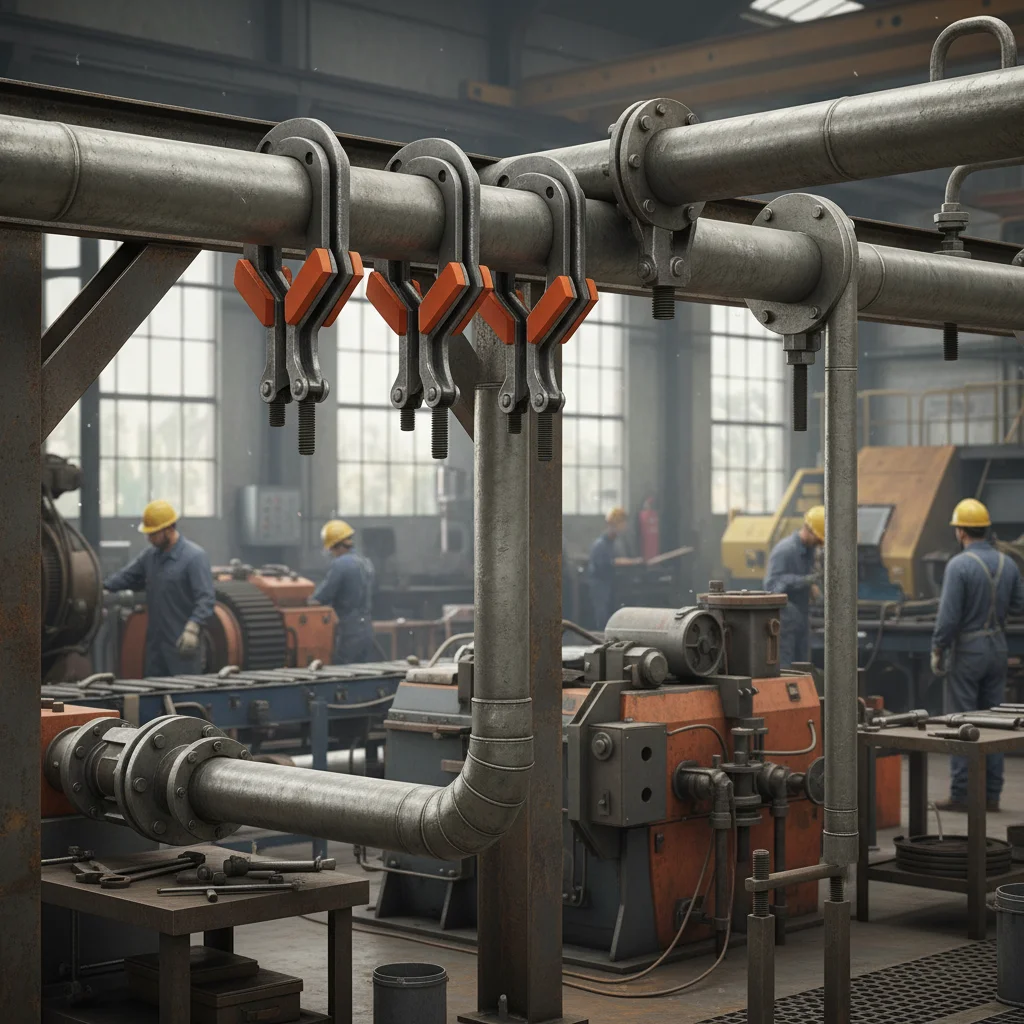
The two-piece clamp design is engineered to distribute pressure evenly around the circumference of the rail and post. By utilizing two interlocking steel components, the system creates a high-friction grip that minimizes the reliance on the bolt's tensile strength alone to hold the structure in place.
This specific architecture is optimized for 1 3/8" rail and post sizes, ensuring a snug fit that prevents lateral movement. When combined with 5/16" x 2" carriage bolts, the assembly forms a rigid T-shaped joint. This configuration is particularly effective in high-traffic areas where the fence must withstand repeated physical impact.
From a manufacturing perspective, the separation of the clamp from the fastening hardware (nuts and bolts) allows procurement teams to specify different coating levels for the bolts—such as galvanized or stainless steel—depending on the specific corrosion environment of the project site.
The longevity of a structural clamp depends on the grade of steel used and the precision of the forging process. Inconsistent wall thickness in a clamp can lead to "ovaling" under pressure, which creates gaps that allow moisture to penetrate and accelerate internal corrosion.
Structural reliability in bulk fasteners is determined by the defective rate; a threshold below 0.05% is essential for industrial-grade applications to prevent systemic failures in large-scale installations.
Handan Guanbiao Metal Products Manufacturing Co., Ltd. addresses these concerns through a rigorous quality philosophy, leveraging over 24 years of experience to ensure that every batch produced in their 30,000㎡ base adheres to precise dimensional standards, reducing on-site installation errors.
Evaluating the efficacy of different clamping methods requires looking at a variety of indices, including load-bearing capacity, installation speed, and corrosion resistance. In high-volume projects, the time required to assemble a single joint can aggregate into hundreds of labor hours.
A standardized two-piece design simplifies the assembly process, allowing technicians to secure connections rapidly without specialized tools beyond a standard wrench. This efficiency is a primary driver for contractors seeking clamps wholesale for rapid deployment.
In a typical industrial setting, such as the perimeter securing of a chemical plant or a large-scale commercial warehouse, the rails and posts must withstand not only static loads but also dynamic wind loads. The use of steel clamps that fit precisely to 1 3/8" dimensions eliminates the "play" in the system, which is where most structural fatigue begins.
Procurement managers often prioritize suppliers who can provide integrated solutions. While the clamps are the primary connection point, the accompanying nuts and bolts—specifically 5/16" x 2" carriage bolts—must be matched in material grade to prevent galvanic corrosion, which occurs when dissimilar metals react in humid environments.
The industry is moving away from generic hardware toward application-specific components. Modern fastening standards now demand higher precision in CNC machining and automated forging to ensure that parts are interchangeable across different production batches, a necessity for global supply chains.
Innovation in this sector is currently focused on corrosion-resistant alloys and automated quality control. With the integration of laser cutting and precision lathes, manufacturers can now produce clamps with tighter tolerances, ensuring that the "T-shaped" connection remains stable even under extreme thermal expansion and contraction.
For companies like Handan Guanbiao, this evolution is reflected in their investment in over 120 precision machines, allowing them to scale production to 500,000 pieces monthly while maintaining a defective rate of less than 0.05%.
When negotiating clamps wholesale contracts, the evaluation should extend beyond the quote. Buyers must analyze the manufacturer's production capacity and their ability to handle custom specifications, as standard sizes may not always fit specialized industrial requirements.
The trade-off between lead time and quality is a common friction point. Automated warehousing and optimized logistics can reduce delivery times significantly, but only if the upstream manufacturing process is stable. A repeat order rate of over 90% is typically a strong indicator of this stability.
The following framework provides a relative assessment of key factors that B2B buyers should consider when selecting a structural hardware partner.
| Evaluation Factor | Low-Cost Provider | Precision Specialist | Strategic Impact |
|---|---|---|---|
| Dimensional Accuracy | Variable | High (CNC) | Reduces On-site Labor |
| Defective Rate | 2% - 5% | < 0.05% | Prevents Project Delays |
| Production Scalability | Limited | Very High | Ensures Timeline Adherence |
| Material Consistency | Batch-dependent | Standardized | Long-term Corrosion Control |
| Customization Ability | Low | High | Fits Unique Site Needs |
| Repeat Order Value | Transactional | Partnership-based | Supply Chain Security |
A two-piece design allows for more precise tensioning and a more uniform distribution of pressure around the rail and post. This prevents the deformation of the tubing and creates a significantly more stable T-shaped connection, which is critical for maintaining structural integrity in high-stress environments.
For these specific clamps, 5/16" x 2" carriage bolts are the industry standard. Carriage bolts are preferred because their square neck locks into the clamp, preventing the bolt from rotating during tightening, which ensures a more secure and efficient installation process.
A defective rate below 0.05% drastically reduces the "hidden costs" of construction. When hardware fails during installation or inspection, it leads to costly labor re-work, project delays, and potential safety hazards. High-precision wholesale hardware ensures that the project moves from assembly to inspection without costly interruptions.
While designed for steel, they can be used with any rigid material with an outer diameter of 1 3/8". However, for softer materials like aluminum or certain plastics, caution must be taken during tightening to avoid crushing the material, and the use of protective spacers may be necessary.
Buyers should verify the manufacturer's production capacity, the precision of their machinery (e.g., CNC lathes), and their historical repeat order rate. Requesting a sample batch to test the fit against actual rails and posts is also essential to avoid dimensional mismatches in bulk orders.
Automated warehousing reduces the time between order confirmation and shipment by streamlining picking and packing processes. For high-volume orders, this can reduce delivery lead times by up to 40%, which is crucial for projects with tight deadlines and just-in-time inventory requirements.
The transition toward high-precision, standardized structural components is an inevitable response to the increasing demand for safety and efficiency in global infrastructure. When sourcing clamps wholesale, the focus must remain on the synergy between design logic, material grade, and manufacturing consistency.
By partnering with manufacturers who prioritize a "no-compromise" quality philosophy and possess the scale to deliver consistent results, contractors can eliminate the risks of project delays and structural instability, ensuring a reliable outcome for every installation.

Hit enter to search or ESC to close


