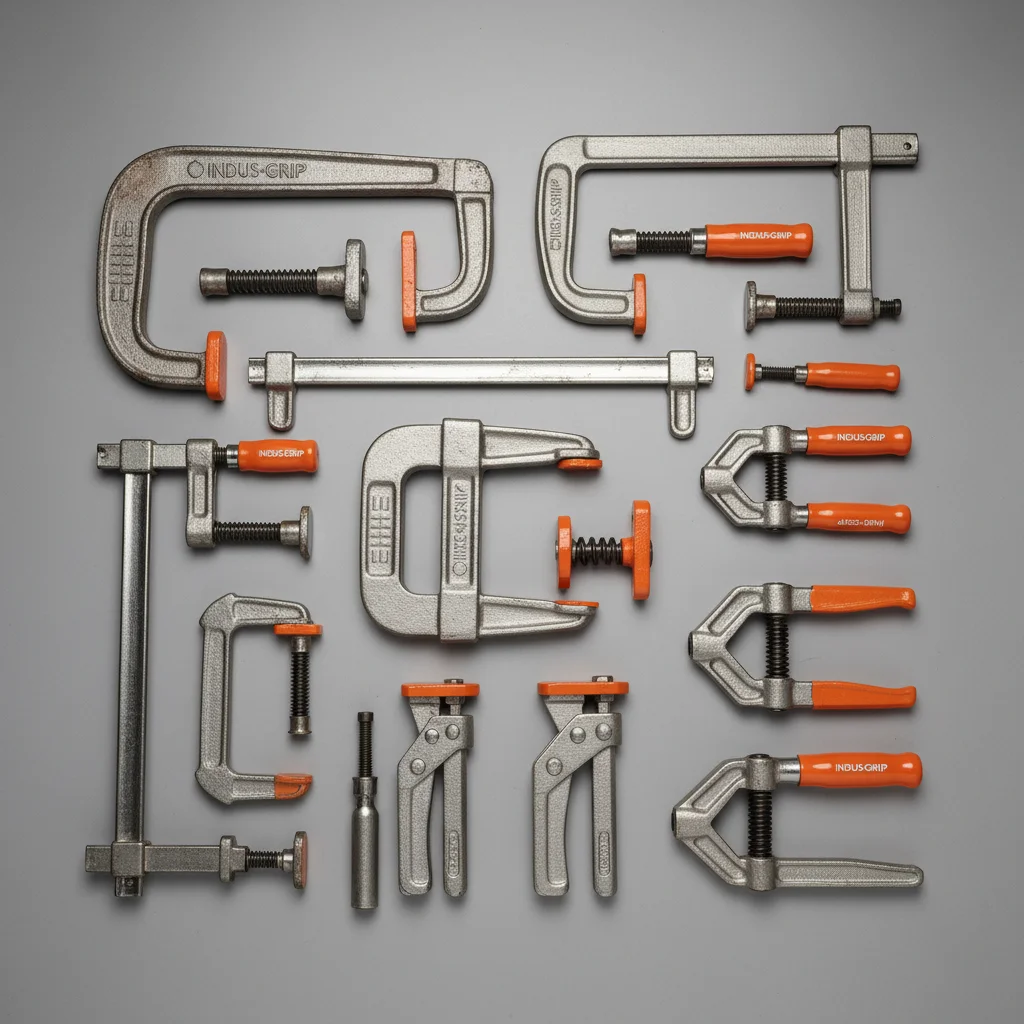
You know, after running around construction sites all year, dealing with dust and grease, you start to see what really matters. Everyone's talking about smart factories and Industry 4.0 now, but honestly, most of what I see is still good old-fashioned elbow grease and reliable tools. And right now, that means clamps – good, strong clamps. It's a simple thing, but get it wrong, and… well, you'll quickly learn why everyone emphasizes safety briefings.
Have you noticed how everyone’s obsessed with lightweight materials? Carbon fiber, aluminum alloys… they’re great for reducing weight, sure, but they’re also more finicky. A lot of designs try to cut corners on the locking mechanism to save a few cents, and that's where things get dicey. I encountered a whole shipment of flimsy toggle clamps at a factory in Ningbo last time – the handles were bending like cooked noodles. They looked nice in the catalog, but they wouldn’t hold a wet paper bag on the shop floor.
And it’s not just about the material; it’s how it feels. Good steel has a weight to it, a solidity. You can smell the oil on it, feel the machining marks. Cheap stuff feels… hollow. Like it’ll crumble the first time you really lean on it. We’re talking about clamps in china here, and a lot of the early stuff coming out was just… not up to snuff. But the quality's definitely improved over the years.
The Current Landscape of Clamps in China
To be honest, the clamp market in China has exploded in the last decade. It's not just about volume anymore; manufacturers are starting to focus on precision and quality. You’ve got everything from basic C-clamps for the workshop to complex quick-release clamps for automated assembly lines. Strangely enough, the biggest driver of this improvement isn't necessarily demand from within China, but from international companies looking for reliable sourcing.
It's become a really competitive space. A lot of smaller workshops popped up, trying to cash in, but they’ve been largely weeded out by now. The ones that are left are the ones who invested in better tooling, better materials, and, crucially, better quality control. They’re not just churning out clamps; they’re building a reputation.
Common Design Pitfalls in Clamp Manufacturing
I've seen it time and time again: over-engineered clamps. They try to add too many features, make them too complicated, and end up with something that's actually less reliable. Keep it simple, that's my motto. Another common mistake is skimping on the heat treatment. It looks good on the surface, but if the steel isn’t properly hardened, it'll deform under pressure.
And don’t even get me started on the threads. Rough threads, inconsistent pitch… it makes tightening a nightmare and strips easily. I had a guy yell at me for a good ten minutes last week because a clamp he bought from a discount supplier wouldn't hold. Turned out the threads were completely shot.
Anyway, I think a lot of these issues stem from a lack of understanding of the actual forces involved. Engineers sometimes get caught up in the theoretical calculations and forget about the real-world stresses that clamps are subjected to. Vibration, shock, temperature fluctuations… it all adds up.
Materials Used in High-Quality Clamps in China
You’re going to see a lot of 45 steel used for general-purpose clamps. It’s a good balance of strength and cost. For heavier-duty applications, you’ll want something like 65 manganese steel – it’s much tougher and more resistant to wear. Then there’s S45C, a carbon steel commonly used for precision components. It's a bit more expensive, but it holds tolerances better.
The handle material is also important. A lot of the cheaper clamps use plastic, which cracks easily. The good ones use cast iron with a textured grip. It feels solid in your hand, and it doesn’t get slippery when you're covered in oil. And the springs? Don’t underestimate the springs! A weak spring means inconsistent clamping force.
It's not always about the raw material either. The quality of the forging process makes a huge difference. A poorly forged clamp will have internal stress points that can lead to premature failure.
Real-World Testing and Application Scenarios
Forget the lab tests, okay? Those are useful for baseline measurements, but they don't tell you how a clamp will perform in the real world. We test clamps by putting them through the wringer. We clamp them onto irregular shapes, subject them to vibration, and even dunk them in saltwater to check for corrosion resistance.
I've seen clamps used for everything imaginable – holding parts during welding, securing molds for plastic injection, even temporarily fixing broken machinery. I once saw a guy using a C-clamp to hold together a section of a collapsed scaffold. Not recommended, of course, but it shows how versatile these things can be.
Testing Parameters for Clamps in China
User Behavior and Unexpected Applications
You know, people will use things in ways you never expect. I've seen welders using clamps to hold their coffee mugs, mechanics using them as makeshift paperweights, and even artists using them as part of sculptures. It’s pretty wild.
What surprises me is how often people don’t bother with the quick-release mechanisms. They’ll just tighten the clamp down with whatever they have handy – a wrench, a screwdriver, even a pair of pliers! It's not ideal, but it gets the job done.
Advantages and Disadvantages of Clamps in China
The biggest advantage of clamps in china right now is the price. You can get a decent quality clamp for a fraction of what you’d pay for a brand-name import. But that comes with a trade-off. The lead times can be longer, the communication can be trickier, and you need to be really careful about quality control.
Another plus is the willingness to customize. A lot of Chinese manufacturers are happy to modify their designs to meet your specific needs. But, and this is a big but, sometimes they struggle with complex designs. They’re great at replicating existing products, but less so at innovating.
Honestly, I’ve been impressed with how much the quality has improved over the years, but you still need to do your due diligence. Don't just go for the cheapest option. Look for a supplier with a good reputation and a solid track record.
Customization Options and Case Study
Customization is key. Last month, that small boss in Shenzhen who makes smart home devices insisted on changing the interface to for all his clamps – said it “looked more modern”. It was a pain to retool, honestly, and added a significant cost. But he was adamant, and we made it happen. Turns out it was purely for aesthetics, but he was thrilled.
We’ve also done a lot of work with different coatings – powder coating for corrosion resistance, zinc plating for extra durability. And we’ve modified the handle designs to improve ergonomics. It's all about understanding the customer's needs and finding a way to meet them.
Generally, customization works best for larger orders. The tooling costs can be significant, so it doesn’t make sense for small batches. But for a large-scale project, it can be a game-changer.
Summary of Key Factors for Successful Clamp Procurement in China
| Material Grade |
Quality Control Process |
Customization Feasibility |
Lead Time Expectation |
| 45 Steel (Standard), 65 Manganese (Heavy Duty) |
On-site Inspection, Destructive Testing |
High for Simple Modifications, Limited for Complex Designs |
30-45 Days (Typical) |
| S45C (Precision Components) |
Dimensional Accuracy Checks, Coating Thickness Verification |
Moderate, Dependent on Tooling Availability |
45-60 Days (For Customized Orders) |
| Cast Iron (Handles) |
Visual Inspection for Defects, Strength Testing |
High for Handle Shape and Texture |
25-35 Days (Standard Orders) |
| Spring Steel (Springs) |
Load Capacity Testing, Fatigue Testing |
Limited, Primarily Spring Rate Adjustments |
30-40 Days (Spring Specific) |
| Zinc Plated Steel (Corrosion Resistance) |
Salt Spray Testing, Coating Adhesion Testing |
Moderate, Coating Color and Thickness Variations Possible |
35-45 Days (Including Plating) |
| Powder Coated Steel (Durability) |
Impact Resistance Testing, Coating Uniformity Check |
High for Color and Finish Options |
40-50 Days (Including Coating) |
FAQS
For heavy-duty applications, prioritize material strength – 65 manganese steel is a good starting point. Focus on the locking mechanism’s robustness and ensure consistent clamping force. Don't be swayed by price alone; look for suppliers with demonstrable quality control processes and certifications. Check for hardness ratings and verify they meet your load requirements. Ultimately, a failed clamp can lead to serious downtime and safety hazards.
Third-party inspection is crucial. Hire a reputable inspection agency to visit the factory before production starts and during the final stages. Request samples for your own testing and compare them against your specifications. Don't rely solely on the supplier's self-reporting. And, honestly, if a price seems too good to be true, it probably is.
You’ve got zinc plating, which is a relatively inexpensive option, and powder coating, which offers better durability and a wider range of color options. For highly corrosive environments, consider stainless steel or specialized coatings like epoxy. Salt spray testing is a good way to evaluate the effectiveness of the corrosion protection.
Lead times vary depending on the complexity of the design, the material requirements, and the supplier's workload. Expect at least 45-60 days for a fully customized clamp. It's crucial to provide detailed drawings and specifications upfront to avoid delays and misunderstandings. And factor in extra time for prototyping and testing.
Absolutely. Most suppliers offer logo marking services, either through laser engraving, pad printing, or embossing. The cost will depend on the complexity of the logo and the quantity ordered. Make sure to provide a high-resolution version of your logo to ensure a clean and accurate reproduction.
Language barriers can be a challenge, so it’s helpful to work with a supplier who has English-speaking representatives. Time zone differences can also make real-time communication difficult. Be patient, be clear in your instructions, and confirm everything in writing. It's also helpful to understand basic Chinese business etiquette.
Conclusion
So, where does that leave us? clamps in china have come a long way. They’re no longer just cheap knock-offs. You can find high-quality, reliable clamps at competitive prices, but you need to know what to look for. Focus on material quality, quality control, and clear communication.
Ultimately, whether this thing works or not, the worker will know the moment he tightens the screw. If it feels solid, if it holds, if it doesn’t slip… then it’s a good clamp. And that’s all that really matters. If you're looking for a dependable supplier of clamps in china, visit our website: www.topfastener.com.